

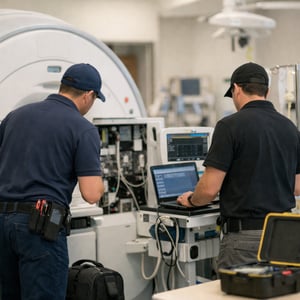
When a surgical boom fails mid-week or a piece of capital equipment goes down in an active clinical environment, the quality of your field service technician determines how fast operations return to normal. A slow response, an incomplete repair, or a technician who is unfamiliar with your equipment manufacturer's protocols doesn't just create inconvenience — it creates operational and financial exposure.
Capital equipment manufacturers, hospital procurement teams, and facility managers all face the same problem: field service work looks similar on paper across vendors, but the actual performance gap between a well-qualified medical field service technician and a generalist is significant. Knowing what to look for before you need someone on-site is how you avoid finding out the hard way.
Technical Qualifications Are the Starting Point, Not the Full Picture
The baseline for any field technician working on healthcare equipment is demonstrable technical training. For biomedical equipment, the Association for the Advancement of Medical Instrumentation (AAMI) offers the Certified Biomedical Equipment Technician (CBET) credential, which requires either an associate's degree in a biomedical program plus two years of full-time field experience, or four years of full-time experience without a degree.
Healthcare equipment spans a wide range of systems:
- Surgical lighting
- OR booms
- Imaging equipment
- Infusion pumps
- Integrated AV systems
Each requires distinct technical experience. A technician who holds general biomedical credentials but has never worked on the specific manufacturer's equipment you use is going to work more slowly, miss nuances in the system, and run a higher risk of needing a return visit.
Manufacturer-specific training matters here. Technicians who have been trained and certified directly by OEMs such as Stryker, Baxter, Medline, or Midmark bring product-specific knowledge that generic credentials don't provide. When evaluating a field service partner, ask specifically which manufacturer certifications their technicians hold, not just what general credentials they have on file.
What a First-Visit Resolution Rate Actually Means
First-visit resolution rate, also called first-time fix rate (FTFR), measures the percentage of service calls resolved completely on the initial visit without requiring a return trip. According to ServiceTitan, the industry average sits around 80%, with 90% considered strong performance.
In a healthcare environment, the gap between those numbers carries real consequences. Every return visit means additional scheduling coordination, more time with equipment offline, and more disruption to clinical workflows. A failed first visit results in an average of 2.7 additional visits and adds approximately 13 days to resolution time, according to field service industry data.
For capital equipment manufacturers deploying field service at scale across multiple facilities, the first-visit resolution rate is one of the most direct indicators of technician quality. It reflects preparation: whether the technician arrived with the right parts, tools, and knowledge of the specific equipment and site. A technician who consistently resolves issues on the first visit is not just faster; they cost less per resolution and create less disruption for the facilities they serve.
When evaluating a field service provider, ask for documented FTFR data, not a verbal claim. A provider confident in their performance will have the numbers.
Nationwide Coverage and What It Actually Requires
For capital equipment manufacturers managing installations or service contracts across multiple health systems, a field service partner's ability to provide consistent, nationwide coverage is not a nice-to-have. It's a baseline requirement.
What nationwide field service coverage actually looks like in practice involves several components that are worth evaluating before signing a contract:
Technician Deployment, Not Contractor Networks
A field service provider that staffs its work through independent contractors rather than full-time, W2 employees introduces variability that is difficult to control. Contractors may lack consistent training, may not follow brand-specific protocols, and may not carry the accountability that a direct employee relationship creates. For healthcare equipment work, where precision and documentation matter, your field service partner's employment model is a quality-control issue.
Full-time, W2 field technicians with assigned company vehicles and consistent oversight produce more reliable results than contractor networks assembled on demand. Background checks, drug testing, and standardized training are also far easier to enforce across a direct employee base.
Response Time and Dispatch Capability
Nationwide coverage means nothing without fast dispatch. Healthcare facilities often have narrow service windows, and urgent break-fix situations don't wait for a convenient scheduling slot. A field service partner with 24-hour dispatch capability and defined response-time commitments is equipped to meet the realities of healthcare operations. One without those capabilities will become a bottleneck when it matters most.
High-Volume Deployment Experience
Some field service needs aren't single-site emergencies – they're large-scale rollouts across dozens or hundreds of facilities simultaneously. Installing several thousand units of a small medical device across a health system, or executing a corrective product field action (PFA) across multiple locations on a compressed timeline, requires a field service division with the logistics infrastructure to support it. Not every provider can operate at that scale while maintaining quality and documentation standards.
Soft Skills and Site Conduct Matter in Clinical Environments
A field service technician working inside an active hospital, surgery center, or clinic is not just a repair person. They are operating in a regulated, patient-facing environment where their conduct, hygiene, communication, and awareness of infection control protocols directly reflect on the manufacturer or facility that brought them in.
The qualities worth evaluating beyond technical credentials:
Infection Control Awareness
Any technician working in a live clinical environment should understand and follow the facility's infection control requirements without needing reminders. That includes proper PPE, containment procedures, and awareness of their location relative to patient care areas. This is not a soft expectation; rather, it is a patient safety issue.
Communication and Documentation
A field technician who completes the repair but leaves incomplete service documentation or fails to communicate clearly with the facility's biomedical or facilities team creates downstream problems. Service records, parts used, work performed, and any required follow-up should be documented accurately and handed off to the appropriate contact before the technician leaves the site.
Customer-Facing Professionalism
Hospitals and health systems form impressions of equipment manufacturers in part through the behavior of the field technicians who service their equipment. A technician who is disorganized, uncommunicative, or difficult to work with reflects poorly on the OEM. A technician who is prepared, professional, and easy to coordinate with strengthens the manufacturer-facility relationship.
What to Ask a Field Service Provider Before You Commit
Before entering a service agreement with a field service partner for healthcare equipment, these are the questions that separate a capable provider from one that will underperform when the stakes are real.
Are technicians W2 employees or independent contractors?
The answer tells you a great deal about consistency, accountability, and training standardization. W2 employees are easier to train in brand standards, hold accountable to protocols, and conduct background checks consistently.
What is your documented first-visit resolution rate?
Ask for the number and ask how it is measured. A provider without a clear answer is either not tracking it or not proud of it.
Which manufacturer certifications do your technicians hold?
If the answer is vague, that is your answer. Technicians working on OEM equipment should have documented, product-specific training.
What does your dispatch process look like for urgent calls?
For break-fix situations and warranty repairs in healthcare settings, response time matters. Understand what the actual process is, not just the advertised SLA.
Can you support high-volume, multi-site deployments?
If your needs extend beyond single-facility service to national rollouts or corrective field actions, confirm that the provider has the infrastructure to handle them.
Key Takeaways
- First-visit resolution rate is the most direct measure of field service technician quality. The industry average is around 80%; a failed first visit adds an average of 2.7 additional trips and 13 days to resolution time.
- Manufacturer-specific certifications matter more than general biomedical credentials when the technician is working on OEM equipment. Ask which product lines the technician has been trained on, not just what credentials they hold.
- Nationwide field service coverage requires W2 employees, not contractor networks. The employment model is a quality-control issue, not an administrative one.
- In clinical environments, infection control awareness, clear communication, and accurate documentation are not soft skills — they are operational requirements that protect patients and manufacturer relationships.
Our Field Service division provides preventive maintenance, break-fix repairs, warranty support, and corrective product field actions for capital equipment manufacturers and healthcare facilities coast to coast. Our technicians are full-time W2 employees, background-checked, drug-tested, and manufacturer-trained across a wide range of OEM equipment, with a 99% first-visit resolution rate and 24-hour dispatch for urgent calls.
If you need a reliable field service partner with the coverage and credentials to perform consistently, connect with our team to talk through your program requirements.