

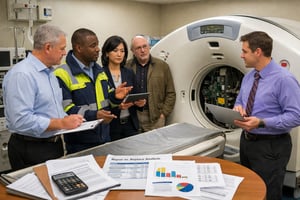
When a surgical boom fails or an OR table stops performing to spec, facilities teams face the same decision every time: repair it or replace it. The answer depends on more than the cost of the fix. Equipment age, manufacturer support status, parts availability, and where the piece of equipment sits in its medical equipment lifecycle all factor into whether repair extends useful life or delays an inevitable replacement.
Getting it wrong costs more than a line item. A repaired system that fails again six months later means a second disruption, a second mobilization, and a second window of downtime in a clinical environment where downtime runs at $7,200 per OR hour.
Four Conditions That Justify Repair Over Replacement
Repair produces the better outcome when four conditions hold: the equipment sits within its manufacturer-supported service life, replacement parts are available and stocked, the failure is isolated to a single component rather than systemic wear, and the remaining useful life justifies the intervention cost.
For equipment still under original equipment manufacturer (OEM) support, repair through a manufacturer-trained technician preserves warranty coverage and ensures the fix meets the original installation standard. The Association for the Advancement of Medical Instrumentation (AAMI) publishes equipment maintenance standards that many health systems use to structure repair vs. replacement decisions formally.
Repair also makes sense when replacement requires a capital budget cycle that has not started. A well-executed repair on a system with two to three years of remaining useful life buys time for proper replacement planning, procurement, and installation scheduling.
Preventive Maintenance vs. Break-Fix: Why the Difference Matters
Preventive maintenance and break-fix service carry different risk and cost profiles for the same equipment, and which one a facility relies on shapes how the repair vs. replacement decision lands.
Preventive maintenance runs on a scheduled basis, independent of whether the equipment has failed. Technicians inspect, calibrate, and service components before wear produces a failure. Facilities that maintain consistent preventive maintenance records have better data for repair vs. replacement decisions: they know failure frequency, parts history, and whether a system trends toward end of useful life or holds steady.
Break-fix service is reactive. A failure triggers a service call, and the repair cost gets evaluated in isolation rather than against a maintenance history. Facilities that rely primarily on break-fix service face repair vs. replacement decisions under time pressure, without the longitudinal data that preventive maintenance records provide.
The AAMI's guidance on medical equipment maintenance distinguishes between planned and unplanned maintenance and recommends moving high-use capital equipment onto preventive maintenance schedules to reduce unplanned downtime. For OR equipment, where an unplanned failure affects the surgical schedule rather than a back-office function, the cost of reactive maintenance compounds quickly.
Signs Your Equipment Has Reached the End of Life
- The Manufacturer Has Discontinued Support. When an OEM ends service support for a product line, spare parts become scarce and technician expertise thins out. A repair that works today may not be repeatable in 18 months.
- The Failure Is Systemic, Not Isolated. A single component failure in an otherwise healthy system is a repair problem. Recurring failures across multiple components, or failures that trace back to structural wear rather than a discrete part, signal end of useful life.
- The Equipment No Longer Meets Current Standards. Infection control requirements, electrical standards, and clinical workflow expectations evolve. Equipment that met code at installation may not meet current Joint Commission Environment of Care standards or current NFPA 99 Health Care Facilities Code requirements after a facility renovation or standard update.
- The Repair Cost Approaches Replacement Cost. A common benchmark in facilities management is the 50% rule: if repair cost exceeds 50% of replacement cost for a system past its midpoint of useful life, replacement produces better long-term value. This benchmark is not universal, but it provides a structured starting point for capital planning conversations.
How the Life Cycle of a Medical Device Affects the Decision
The life cycle of a medical device runs from installation through end-of-manufacturer-support, and where a piece of equipment sits in that cycle determines how much weight to give repair vs. replacement arguments.
Most major surgical equipment categories carry manufacturer-defined service lives:
- Surgical booms and lights: typically 10 to 15 years, depending on the manufacturer and usage intensity
- OR tables: 10 to 20 years, with hydraulic and electrical components often requiring service before full table replacement
- Sterilization equipment: 10 to 15 years, with chamber and seal integrity as the primary lifecycle indicators
- Nurse call and OR equipment management systems: 7 to 12 years, often driven by software support timelines rather than hardware wear
Facilities teams that track medical equipment lifecycle data through a Computerized Maintenance Management System (CMMS) or capital planning platform make faster, more defensible repair-versus-replacement calls than those relying on institutional memory alone.
What Replacement Actually Involves in a Clinical Environment
Replacing equipment in an active clinical facility is as much a logistics problem as a procurement problem. The clinical environment stays operational. Cases continue. Staff work around a construction window that has to be planned, not assumed.
A surgical boom replacement requires ceiling access, structural verification, medical gas disconnection and recertification under NFPA 99, and OEM-standard reinstallation of the new unit. With proper coordination, a single-boom replacement takes five to seven days. Done without it, the project runs longer and creates downstream scheduling pressure on the surgical program.
Medical equipment installation in an active facility also requires Infection Control Risk Assessment (ICRA) compliance throughout the work window, including barrier management and air quality controls that protect adjacent clinical spaces. The American Society for Health Care Engineering (ASHE) defines the ICRA classification framework that governs this work in occupied healthcare facilities.
Multi-site or multi-room replacement projects carry coordination complexity that single-site replacements do not: standardized installation documentation, OEM sign-off at each location, and a project management layer that keeps individual sites on schedule.
Build a Replacement Plan Before the Equipment Fails
Reactive replacement costs more and disrupts more than planned replacement. Facilities teams that build a rolling three-to-five-year capital equipment replacement plan can schedule installations during low-volume clinical windows, bundle multi-room or multi-site work for efficiency, and give procurement enough lead time to avoid supply chain delays on long-lead items like surgical booms and imaging infrastructure.
The inputs are straightforward: installation date, manufacturer service life, current maintenance history, and a realistic assessment of whether the equipment will meet standards and clinical requirements through the next planned replacement cycle. For facilities managing healthcare renovation projects alongside equipment replacement, coordinating the two timelines produces better outcomes than running them independently.
How KR Wolfe Supports Both Sides of the Decision
KR Wolfe's Field Services division handles the repair and maintenance side: break-fix, preventive maintenance, medical device repair, certified parts repair at regional depots, corrective Product Field Actions (PFA), and on-demand biomedical technician (BMET) staffing. The division operates at a 99% first-visit resolution rate and serves OEMs, including Stryker, Baxter, Medline, and Midmark, nationwide.
When repair is not the answer, KR Wolfe's Equipment Installation division manages the replacement: surgical booms and lights, OR tables, sterilization equipment, modular ceiling systems, medical gas infrastructure, and owner-furnished contractor-installed (OFCI) equipment across single-site and multi-site projects. Technicians train directly with OEMs, ensuring installations meet manufacturer specifications rather than just general construction standards.
For replacements that involve structural or facility work alongside equipment, KR Wolfe's construction services operate under the same project coordination, reducing the handoff risk associated with multiple contractors in the same clinical space.
KR Wolfe holds Women's Business Enterprise National Council (WBENC) certification as a women-owned business, relevant for health systems with supplier diversity requirements.
Plan the Next Step Before the Next Failure Forces It
If your facility has equipment approaching the end of manufacturer support, showing recurring maintenance issues, or coming up in a capital planning cycle, reach out to KR Wolfe to discuss whether repair or replacement makes sense and what the coordination looks like either way.